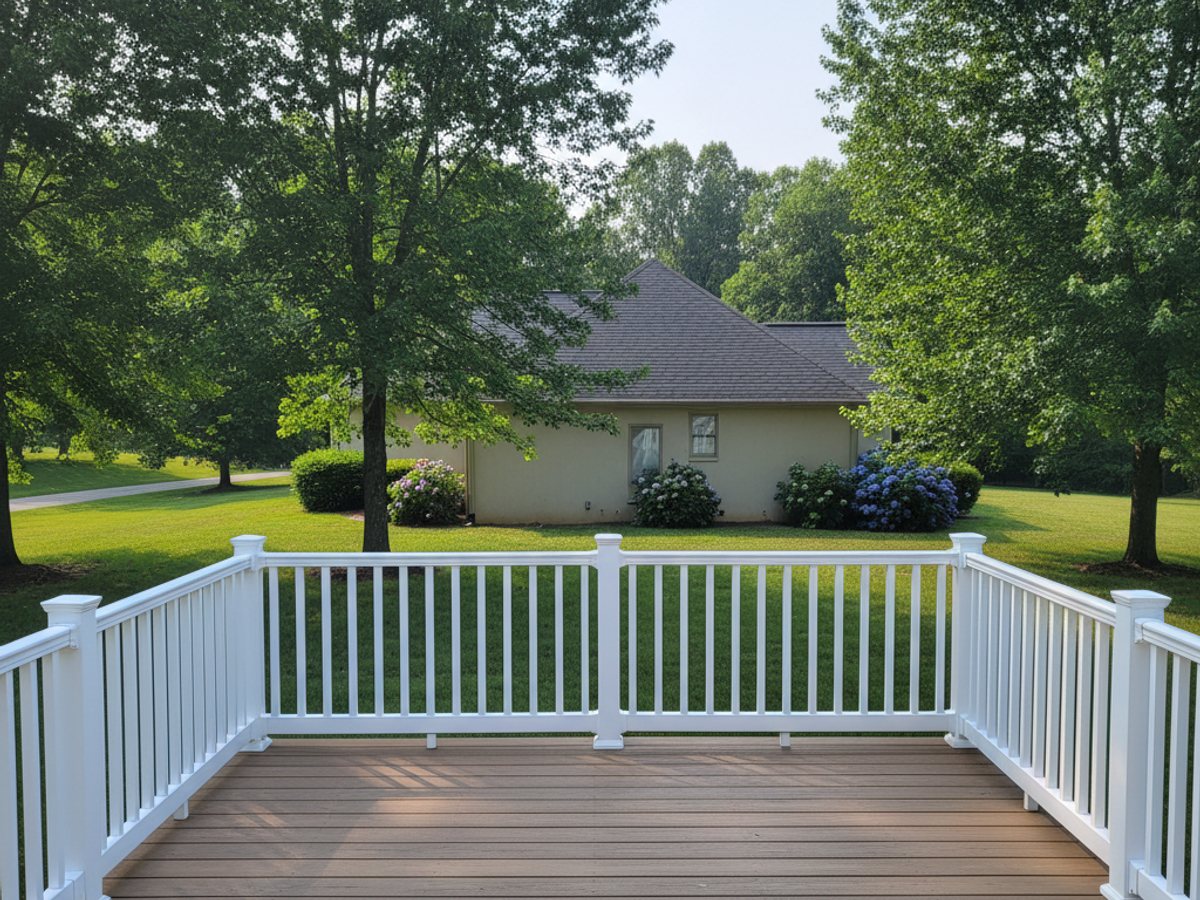
A deck is one of the few home projects where the mistakes are invisible for a year or two and then show up all at once. A footing that's too shallow doesn't fail in month one. It fails the third spring, when Memphis clay swells with rain and shifts the post just enough to rack the frame. Picking the right builder is mostly about picking someone who thinks about that third spring, not just the ribbon-cutting photo.
Ask how deep the footings go, and why
Our frost line in Shelby County is shallow, usually cited around 12 inches, so frost heave isn't the main worry here the way it is up north. The bigger issue is our clay soil itself. It expands when it's wet and shrinks hard when it dries out in July and August, and that movement will walk a post footing sideways over a few seasons if it isn't poured deep and wide enough. A builder who knows the ground here will typically set footings down around 24 to 36 inches with a bell shape or a wider base, not just an 8-inch sonotube dropped in a hole. Ask them directly how deep they're going and what diameter. If they shrug, that's your answer.
This matters more in older parts of town, Midtown, Cooper-Young, Vollintine Evergreen, where houses were built in the 1920s through 1950s and the yards have decades of fill, old tree roots, and sometimes an old walkway or foundation fragment buried where you'd least expect it. A good builder digs a test hole before they commit to a footing plan. In newer subdivisions out in Collierville, Bartlett, or Cordova, the grading is more consistent, but the clay content is often just as high, so the footing depth conversation still applies.
Permits aren't optional, and a real builder won't dodge them
Any deck attached to the house, and most freestanding ones over a certain height, need a permit through the city or county building department depending on where the lot sits. The inspector generally wants to see the footings before they're covered, and the framing before the decking boards go down. That's two site visits minimum. A builder who says "we don't bother with permits, it just slows things down" is telling you they're willing to build something that isn't inspected for structural soundness, which is exactly the thing you're paying them to get right. It also becomes your problem at resale, because an unpermitted structure can hold up a home sale or an insurance claim. If you're in an HOA neighborhood, common in a lot of the newer Collierville and Germantown subdivisions, there's usually also a design or setback approval step before the city permit even comes into play. Ask who's pulling the permit and get it in writing that it's their responsibility, not yours.
What they build it out of, and whether they understand our climate
Pressure-treated pine is still the most common frame and decking material here, and it's a fine choice, but it comes out of the treatment plant wet. It needs 30 to 60 days to dry out before it will take a stain properly, longer in our humidity. A builder who wants to stain the deck the week it's built either doesn't know that or is hoping you don't. Composite decking sidesteps the staining question entirely and holds up better against Memphis humidity and the swings between a wet spring and a dry August, but it costs more up front and still needs the frame underneath built to the same standard.
Ledger board attachment is the other place corners get cut. That's the board bolted to the house that the whole deck hangs off of. It needs flashing behind it so rain doesn't run down between the ledger and the siding or brick veneer and rot the house framing from the inside, which is a slow, expensive problem to discover later. On older brick homes this takes more care than on newer homes with house wrap already in place. Ask what flashing they use and whether they're using lag bolts or through-bolts, not just nails, to hang that ledger.
What a real bid looks like, and what a bad one looks like
A serious bid names the footing depth, the joist spacing, the fastener type, and the material, board by board. It will usually take a week or two to put together because they're actually measuring the lot and checking the soil, not guessing off a photo. A bid that comes back same-day and is dramatically lower than everyone else's is usually missing something, most often the permit, the footing depth, or a real material spec. Cash-only pricing with no written contract is a walk-away sign by itself. So is a contractor who can't tell you their license and insurance status without hesitating. Ask for proof of general liability insurance at minimum. If a worker gets hurt on your property and the company isn't insured, that liability can land on you.
It's also worth asking how many decks they've built in the county recently versus how many they've repaired. A builder who does both new builds and repair work has seen what fails and why, which usually makes them better at the new build too. Someone who's only ever framed new decks hasn't had the education of pulling up a rotted board and finding out what caused it.
Get more than one walk-through
Have at least two builders actually walk your yard before you sign anything. A phone quote off square footage alone skips the two things that matter most here, the slope of the lot and the drainage. Memphis gets hard, fast thunderstorms in spring, and a poorly graded yard will pool water right at the base of your new posts if the builder didn't account for it. Someone standing on your actual grass, looking at where the downspouts empty and which way the yard slopes, will catch that. Someone quoting from a satellite photo won't.
A deck built right here should handle our summers, our clay, and our spring storms for decades with basic staining or sealing upkeep every few years. If you want a second opinion on a design or a quote you already have, or you're starting from scratch, take a look at our deck builder work around Memphis and the surrounding towns.